



 Repair, strengthening & anchoring › Concrete repair mortars
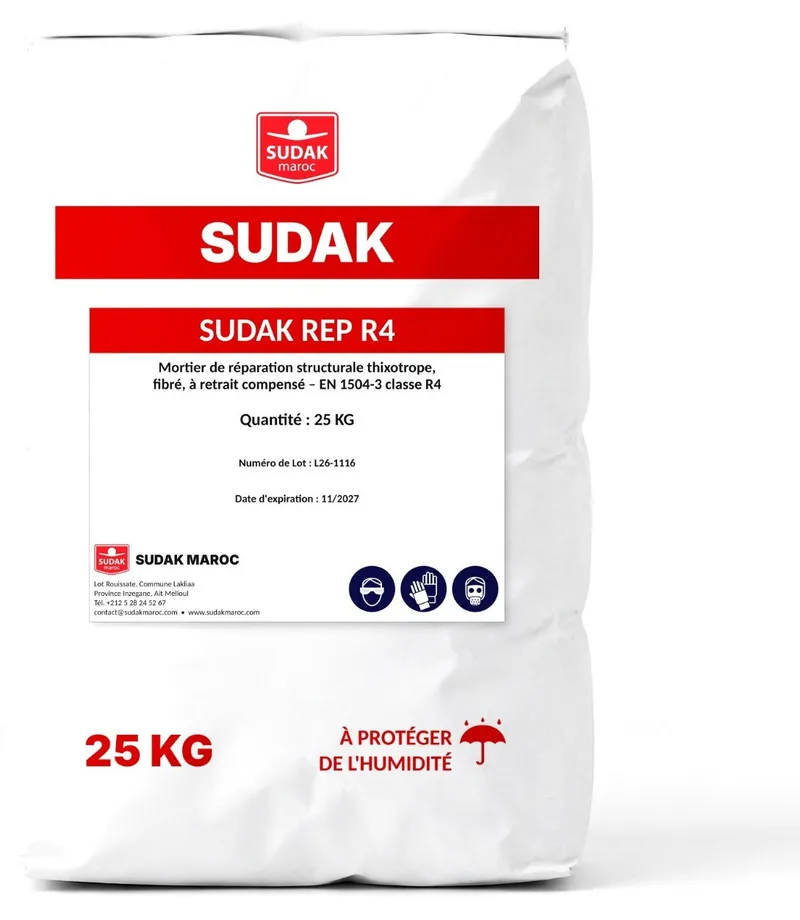
SUDAK REP R4
Thixotropic, fibre-reinforced, shrinkage-compensated structural repair mortar – EN 1504-3 class R4
- EN 1504-3
SUDAK Maroc — ISO 9001:2015 certified company (SGS) · see the scope
SUDAK REP R4 is a ready-to-mix, single-component structural repair mortar with high strength and a high modulus of elasticity, reinforced with polymer fibres and shrinkage-compensated. It is composed of Portland cement, precisely graded aggregates, selected polymer fibres and specific additives that limit shrinkage and the risk of cracking. Mixed with water, it forms a highly thixotropic mortar that can be applied by hand or by spraying, without formwork. Complies with standard EN 1504-3, class R4.
Applications
- Repair and strengthening of reinforced concrete structures: columns, beams, slabs, floors.
- Piers, abutments and beams of bridges, viaducts and dykes.
- Cooling towers, chimneys and industrial environments.
- Water treatment structures and wastewater treatment plants.
- Tunnels, pipelines, dams and buried structures in aggressive soils.
- Structures in marine environments.
- Repair of fair-faced and precast concrete masonry.
Benefits
- Can be applied indoors and outdoors, on vertical surfaces and soffits, in dry or damp conditions.
- Highly thixotropic: application without formwork.
- Shrinkage-compensated and polymer-fibre-reinforced: minimised risk of cracking.
- High early and final strength; high modulus ensuring good load transfer.
- Excellent adhesion to concrete and reinforcement.
- Excellent resistance to freeze-thaw cycles and carbonation; sulphate-resistant.
- Very low permeability to water and chlorides; chloride-free.
- No primer required on concrete.
Technical specifications
| Property | EN standard | Value |
|---|---|---|
| Appearance | — | Grey powder |
| Maximum aggregate size | — | 1.5 mm |
| Thickness per layer | — | 5 to 30 mm |
| Fresh mortar density | — | ≈ 2.2 kg/L |
| Mixing water | — | 3.8 to 4.2 L per 25 kg bag |
| Pot life at 20 °C | — | 20 minutes |
| Application temperature (substrate and product) | — | +5 to +30 °C |
| Compressive strength at 24 h | EN 12190 | > 18 MPa |
| Compressive strength at 28 d | EN 12190 | ≥ 45 MPa (class R4) |
| Flexural strength at 28 d | EN 12190 | > 6.5 MPa |
| Modulus of elasticity at 28 d | EN 13412 | ≥ 20 GPa |
| Bond strength to concrete at 28 d | EN 1542 | ≥ 2.0 MPa |
| Bond strength after 50 freeze-thaw cycles with salts | EN 13687-1 | ≥ 2.0 MPa |
| Bond strength after thunder-shower cycling | EN 13687-2 | ≥ 2.0 MPa |
| Bond strength after dry thermal cycling | EN 13687-4 | ≥ 2.0 MPa |
| Carbonation resistance | EN 13295 | dk ≤ reference concrete |
| Capillary absorption | EN 13057 | ≤ 0.5 kg·m⁻²·h⁻⁰·⁵ |
| Chloride ion content | EN 1015-17 | ≤ 0.05 % |
Typical values obtained in the laboratory at +20 °C and 60 % RH. Higher temperatures shorten these times, lower temperatures lengthen them.
Standards / Classification
Complies with standard EN 1504-3, class R4.
Packaging
SUDAK REP R4 is supplied in 25 kg bags.
Storage
Store away from sunlight and moisture, in a cool, dry place, on pallets off the ground, in the unopened, undamaged original packaging. Shelf life: 12 months.
Application
Substrate preparation
Concrete: the substrate must be sound, with a surface tensile strength of at least 1.5 MPa, clean and free from laitance, oil, grease and loose material. Remove deteriorated or contaminated concrete preferably by high-pressure hydrodemolition or shot blasting, methods without impact or vibration; the aggregates must be clearly exposed at the surface. Saw-cut the edges of the repair vertically to a minimum depth of 5 mm: feather-edged repairs are not permitted.
Reinforcement: expose the bars around their entire circumference and clean them to grade Sa 2 (ISO 8501-1). Protect them with SUDAK PASSIVATION, particularly in the presence of chlorides or where cover is low.
Pre-wetting: saturate the substrate with water 24 hours beforehand and then at least 2 hours before application; at the time of application, the surface must be matt damp, without standing water.
Mixing
- Mix whole bags only; do not use opened or damaged bags.
- Pour 3.8 to 4.2 L of drinking water into the mixer, then add the powder continuously.
- Mix for about 3 minutes with a slow-speed electric mixer until a homogeneous, creamy mortar is obtained.
- Leave to stand for 2 to 3 minutes, then remix briefly, adjusting the consistency without going outside the stated water range.
Application
- Apply by trowel or by spraying onto the damp substrate, or wet-on-wet onto a thin scratch coat of the same mortar firmly pressed into the substrate, recommended for hand application.
- Apply in layers of 5 to 30 mm. For greater thicknesses, wait at least 60 minutes between layers and roughen the previous layer.
- On large areas, install a reinforcing mesh pinned to the substrate, and provide joints delimiting panels larger than 9 m².
- Level with a straightedge or float, then smooth with a trowel or finish with a sponge as soon as setting begins.
- Use the mortar within 20 minutes of mixing.
Curing
Careful curing is essential, particularly in hot or windy weather: apply SUDAK CURE W immediately after finishing, or cover with polyethylene sheeting or hessian kept damp.
Precautions for use
- Do not apply below +5 °C or above +30 °C; maintain these temperatures for 24 hours after application.
- Do not add cement, sand or other substances.
- Never add water or fresh mortar to mortar that has started to set.
Cleaning
Clean tools with water while the mortar is still fresh. Hardened product can only be removed mechanically.
Dosage / Consumption
Approximately 2 kg of powder per m² per mm of thickness; a 25 kg bag yields approximately 11 litres of fresh mortar. Theoretical consumption, to be verified on site according to substrate roughness and reinforcement density.
Health and safety
As with all chemical products, avoid contact with the eyes, mouth, skin and foodstuffs. Wear gloves, goggles and protective clothing. In case of splashes on the skin or in the eyes, rinse immediately and thoroughly with water. In case of accidental ingestion, seek medical advice. Reseal containers after use. Refer to the Safety Data Sheet (SDS).
Documents
-

Technical data sheet

