



 Family Architectural & special concretes
Architectural & special concretes
Architectural and special concretes form the most innovative segment of concrete chemistry. It is no longer only about improving mechanical performance, but about giving concrete new aesthetic, functional or structural properties: flow, very high strength, decorative appearance, colour, fibre reinforcement. They meet growing architectural requirements and the drive for more durable, lighter construction.
Ranges
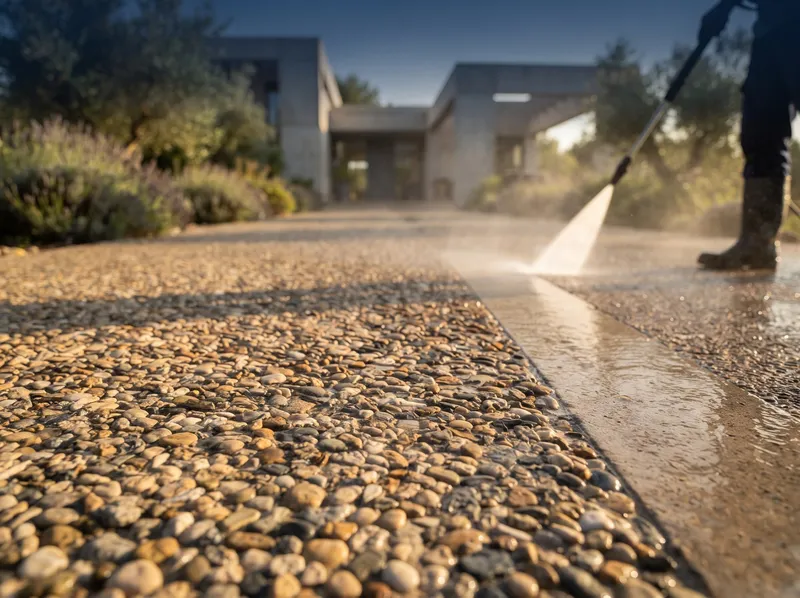
Exposed-aggregate concrete
Surface retarders revealing the aggregates of fresh concrete for a decorative, anti-slip finish. Use them for roads, paths and public spaces.
See products

Coloured concrete
Mineral pigments incorporated in the mass or at the surface for UV-stable coloured architectural concrete. Use them for exposed concrete and prestige structures.
See products 
Stamped & decorative concrete
Coloured hardeners, release agents and sealers for textured and stamped concrete (paths, terraces, pedestrian areas). Use them to reproduce stone, wood or paving in cast concrete.
See products 
High-strength concrete
PCE superplasticisers and silica fume to formulate high-strength, high-performance, low-permeability concrete. Use them for precast elements, slender load-bearing members and demanding structures.
See products Frequently asked questions
What is architectural concrete?
Architectural concrete is concrete whose surface appearance is an integral part of the result, left exposed without a coating. Care is taken over colour, texture, edges and the absence of defects for an aesthetic result. It requires a particularly well-controlled mix, formwork and placing.
What is self-compacting concrete and when do you use it?
Self-compacting concrete is a highly fluid concrete that places and de-airs itself under its own weight, without vibration. It is ideal for complex formwork, dense reinforcement and fine facings. Its formulation relies on superplasticisers and a controlled dosage of fines to avoid segregation.
How do you obtain coloured or decorative concrete?
Concrete is coloured throughout with mineral pigments, or on the surface with coloured hardeners and decorative treatments. The result depends on the pigments, the cement, the aggregates and the consistency of the placing. For a uniform colour, the dosage and curing conditions must be controlled.
What precautions ensure successful exposed concrete?
Successful exposed concrete relies on careful formwork, a suitable release agent and a homogeneous, well-vibrated or self-compacting concrete. Curing must be controlled to avoid colour variations and surface defects. A prior trial panel is strongly recommended before the final structure.
