



 Architectural & special concretes › Exposed-aggregate concrete
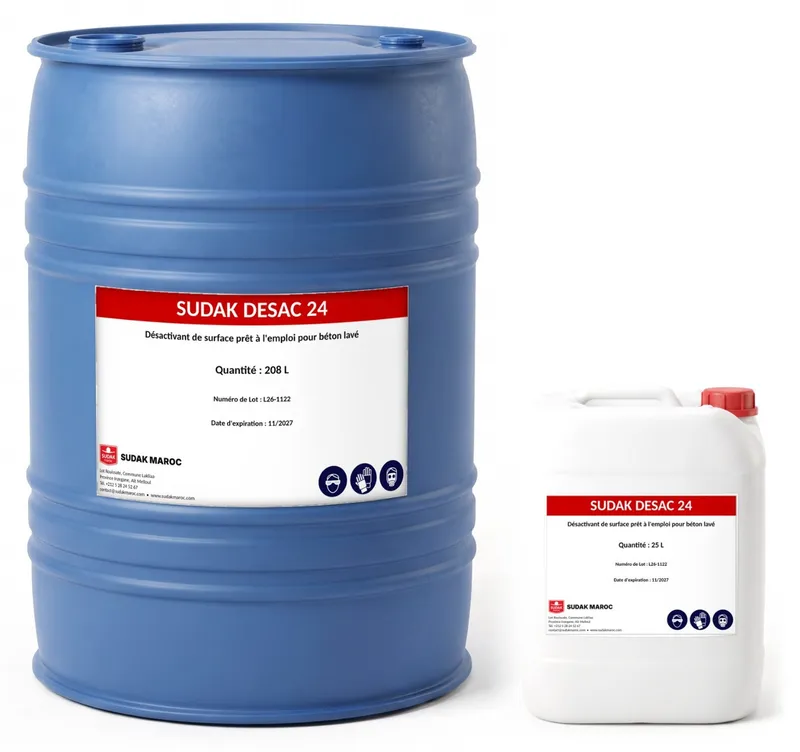
SUDAK DESAC 24
Ready-to-use surface retarder for exposed aggregate concrete
SUDAK Maroc — ISO 9001:2015 certified company (SGS) · see the scope
Aggregates of 6 to 15mm – retardation depth 2 to 4 mm
SUDAK DESAC 24 surface retarder is a simple and economical method for exposing the aggregate of horizontal concrete surfaces. It enables a variety of colours and textures to be obtained on pavements, terraces, promenades and steps.
Applications
- Pavements
- Entrances
- Terraces
- Promenades
- Stairs
- Pool surrounds
- Exposed aggregates.
Benefits
- Suitable for a wide variety of environments
- Excellent results on the top surface
- Easy identification
- Suitable for different surface profiles
- No solvents, no odour, no fume or flammability issues.
Technical specifications
| Colour | Blue |
|---|---|
| Density | Approx. 1 |
| pH | Approx. 8 |
| VOC content | 0 g/L |
Packaging
25 L plastic jerrycan
208 L plastic drum
Application
Placing the concrete
- Prepare a concrete mix that meets the structural and architectural requirements.
- Pour the concrete and level it using a screed board, trowel or float. Do not tamp or overwork the top surface, as you risk pushing the aggregate below the surface and reducing the depth and uniformity of exposure.
- Use a wooden float or a long-handled bull float to work the top surface. Do not overwork the top surface with a steel trowel, as this could close it, which would limit penetration of the retarder.
- Aggregate may be added to the top surface, taking care to embed it completely in the cement paste. (A vibrating compactor can be very useful for this operation.)
Homogenising the retarder: Turn the SUDAK DESAC 24 container upside down, stir and shake it well before pouring it into the sprayer.
- Spray SUDAK DESAC 24 retarder as soon as the surface water has disappeared (after approximately 30 minutes, depending on weather conditions).
- To spray SUDAK DESAC 24 retarder onto the top surface of the concrete, use an ordinary low-pressure garden sprayer at a coverage rate of 4 to 6 m2 /L.
- Protect adjacent areas from overspray, as the retarder could stain them.
Washing with water: The treated surface can be washed on the same day the concrete is poured. However, timing is critical and many factors, such as those detailed below, must be taken into account to ensure an acceptable finish.
Note: You must take into account anything that may affect the setting of the concrete, such as ambient temperature, wind, whether the concrete is in full sun or shade, or poured on flat or sloping ground. With so many variables to consider, it is impossible to give a time for washing the concrete surface. Consequently, proceed as follows:
As soon as the concrete has hardened sufficiently (enough to bear a person's weight), wash a small area to check the depth of retardation. If the retardation is too deep, wait an hour and check again. If the retardation is sufficient, spray the top surface with a water jet and use a broom or stiff brush to remove the retarded matrix and expose the aggregate. High-pressure water is more effective and should be used where possible.
Health and safety
Please note the safety information and advice on the packaging labels and in the Safety Data Sheets (SDS).
Documents
-

Technical data sheet

